


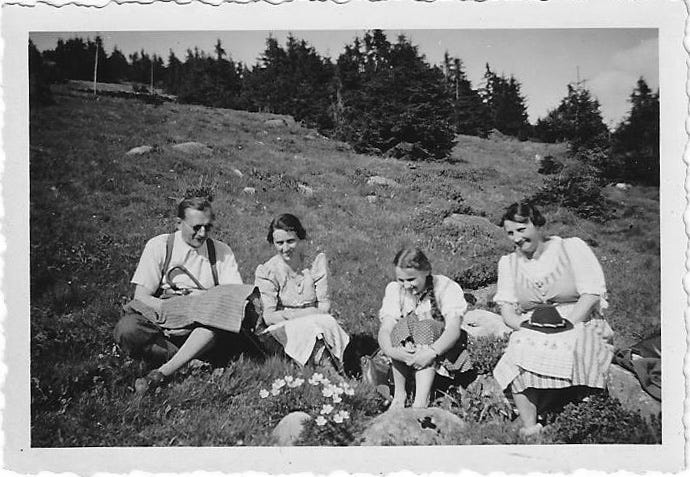
Many a reader or interviewer has told me they were amazed at the amount of research that went into my memoir Jumping Over Shadows.

“Wasn’t that hard?” they would ask. Truth be told, I loved the research, even if research can be quite frustrating. You don’t always find what you expect. Often, you simply have to deal with the void. But without research, I could not have told my great-aunt’s story, and I could not have written Jumping Over Shadows the way I did.
I always knew that my German great-aunt Resi had been married to a Jewish man, Guido Knina, in Czechoslovakia before World War II. However, it wasn’t until I, living in post-WWII Germany, fell in love with a Jewish man that I wanted to know more about Resi’s story. And when I decided that this love between a German woman and a Jewish man happening twice in my family would make a good book, I had to fill in the blanks.
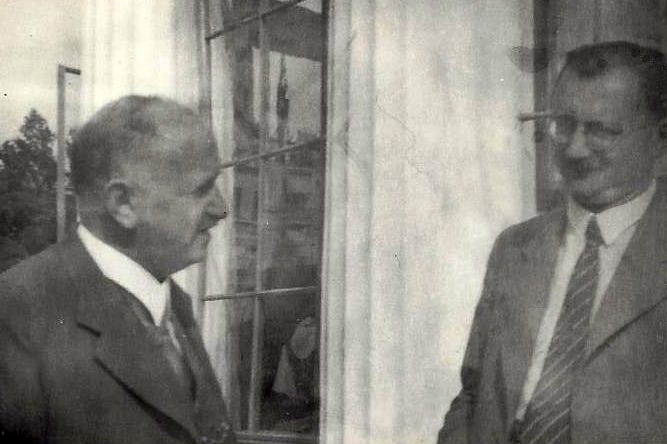
What had really happened to my Jewish great-uncle?
And what had happened to this couple when the Nuremberg Laws, prohibiting marriages between “Aryans” and “non-Aryans,” had taken effect in 1938?
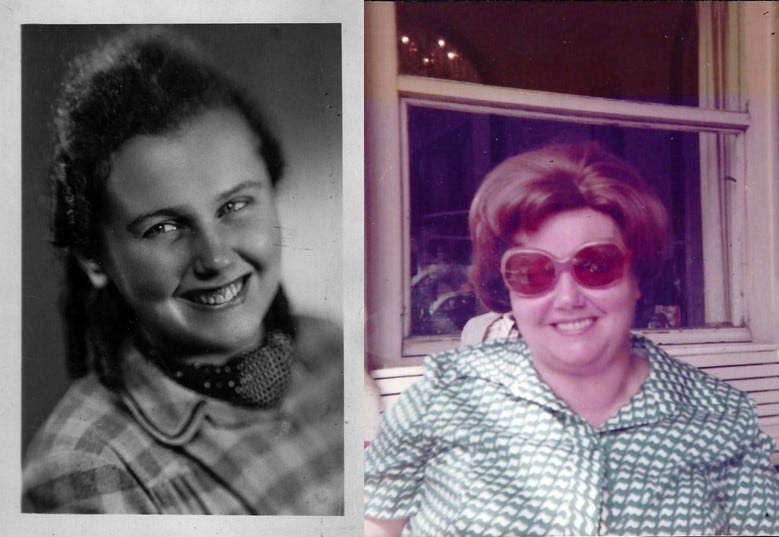
Growing up, I was close to the daughter of this marriage, my dad’s first cousin Herta. She told me many family stories, such as the one about my grandfather’s pride in his Queen of the Night cactus that appears in the book. My grandmother was a gifted storyteller and shared many family stories with me and my siblings. Nevertheless, being aware of family stories is one thing; being able to retell them within their historical context is another.
Step 1: Fit family lore into a historical timeframe.
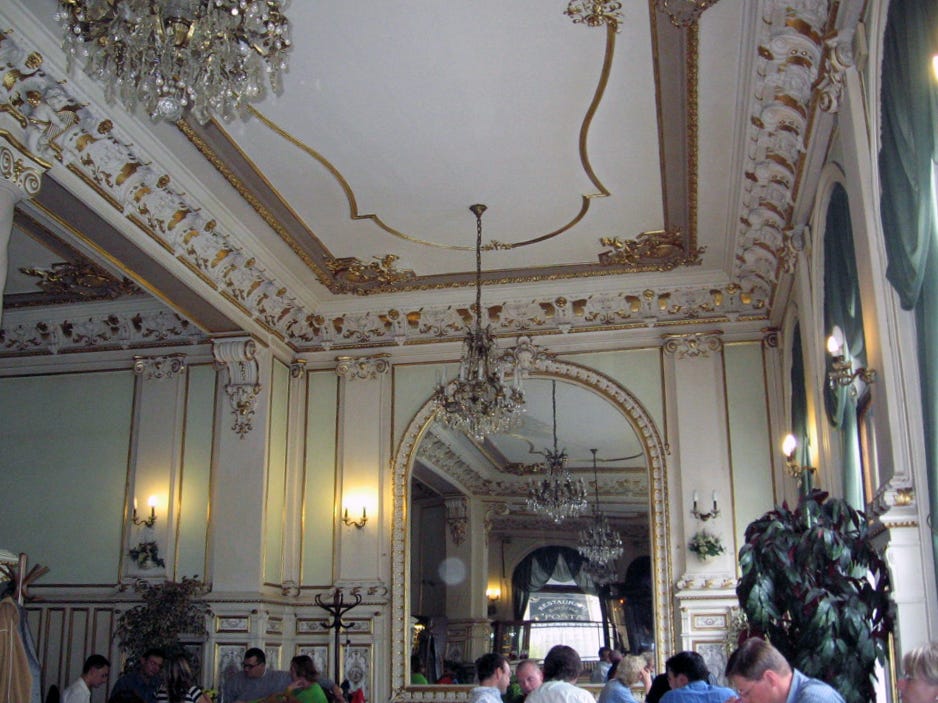
When I traveled to Liberec for the first time in 2002 and told Herta about a beautiful café there, she said, “Oh yes, the Café Post! My father loved to go there on Sunday mornings. My mother didn’t like this, but that was his habit. Until he couldn’t go anymore. But that’s how things were then.”
“That’s how things were then.” By this, she meant that her father, Guido Knina, couldn’t go to the Café Post anymore because he was a Jew. Once that area of Czechoslovakia was annexed by Hitler after the Munich Agreement in 1938, the laws of the German Reich applied. Jews were banned from public places like cafés. But Herta didn’t tell me that. I had to supply that historical context myself.
On another occasion she mentioned, “I always wanted to go to university; I would have loved that. But in those days, it wasn’t possible, so what could I do?” Characteristically, she did not explain that in the 1940s, in a Czechoslovakia annexed by Nazi Germany, she was not able to study because, classified as a half-Jew, she was barred from institutions of higher education. Only when I read my grandfather’s memoirs did I find out he had arranged for her to attend the Handelsakademie (Academy of Commerce), even though technically she was barred from that, too. But the principal was a cousin of my grandmother, and he agreed to let Herta attend unregistered.
Step 2: Research the wider community.
I based the reconstruction of my great-aunt’s story on my grandfather’s memoirs—specifically, his chapter about his sister. However, he only recorded the intersections of Jewish and gentile life as they affected him.
I needed to fill in the blanks if I wanted to contrast my story with my great-aunt’s. Who had her husband been? Who had his family been before they were connected with my family?
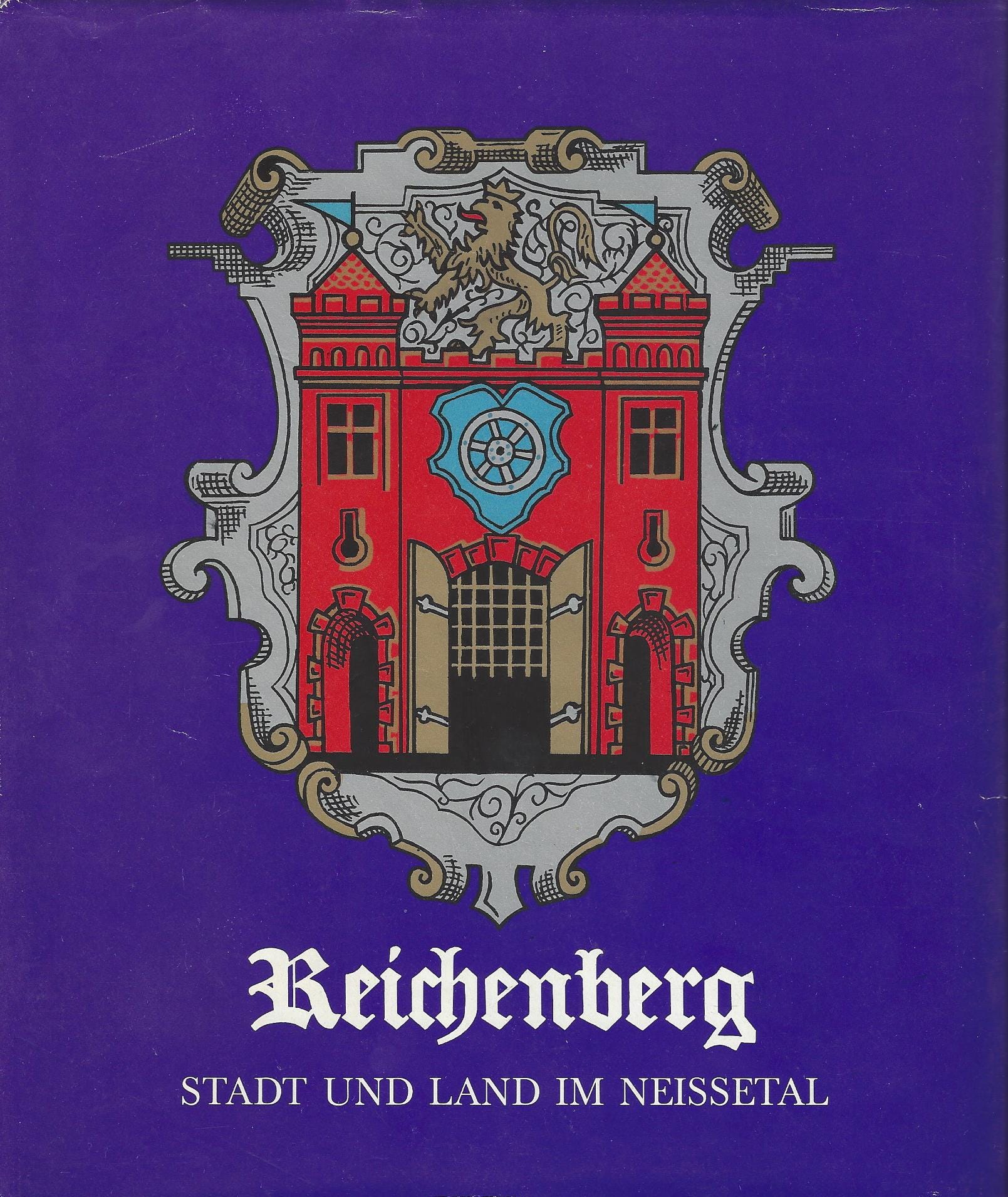
My first find, on the German eBay site, was the book Reichenberg, published in Augsburg in 1974. It included a chapter on “the Israelite Cultural Community in Reichenberg.” Their history was the usual sordid tale of rights granted to Jews and then rescinded, coupled with various harassments, until in 1860 the Jews were given full citizenship by Austro-Hungarian Emperor Franz Josef. Then 30 Jewish families took up permanent residence in Reichenberg, a well-to-do hub for textile and glass manufacturing and trade.
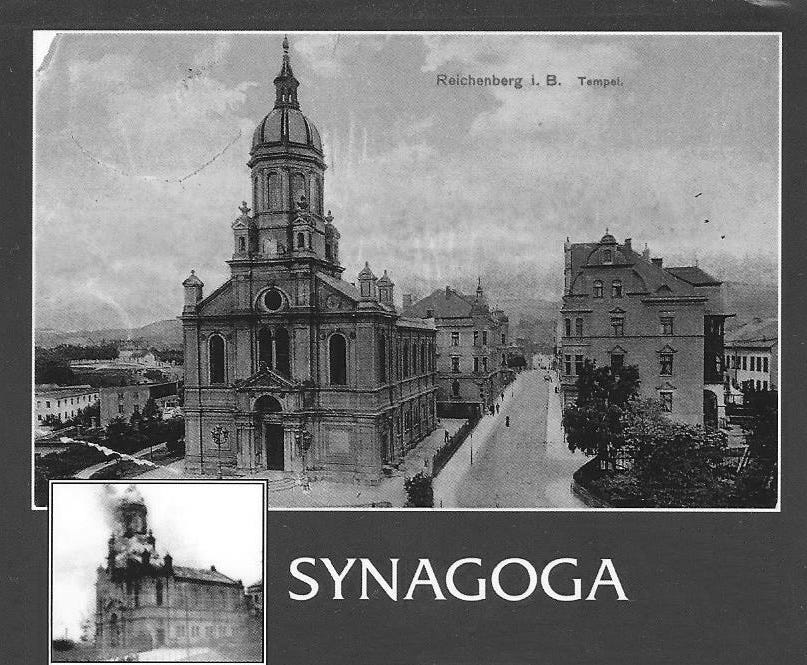
While this chapter didn’t give me specifics on any Jewish families, it did feature an image of the “temple of the Israelite community.” It also cited the image’s source, and that presented another thread for me to follow. Promptly I found an article by Dr. Emil Hofmann, “Geschichte der Juden in Reichenberg” ((the history of the Jews in Reichenberg), published in 1934, on Jewishgen.org.
Here I struck gold: “J.L. Knina” was listed as a member of the temple’s building committee. “J.L. Knina” stood for Joachim Ludwig Knina, father of my great-uncle Guido Knina, which I knew from the family tree in my grandfather’s memoirs. Further on, in a chapter titled “Jews in Non-Jewish Organizations,” I found Guido himself:
“In 1919, Guido Knina was elected to the town council for the Social Democratic Party and remained there for four years.”
From my grandfather’s memoirs, I knew that he and Guido had served as city councilmen at the same time. I did not know, however, that Guido had been the first Jew elected to the city council. This was the kind of information that would be noteworthy to a Jewish audience but not to my grandfather.
Research was needed to fill in the blanks and find the information that was neither part of family lore nor contained in family documents. Ordering books, viewing them online, or borrowing volumes on Czech history from the library was, however, not enough.
Step 3: Hit the archives.
On my trip to Reichenberg in 2009, I went to the public library there and asked whether they had newspapers from 1938. I wanted to read reports from that time, so I would be able to recreate what life had been like then. The archivist told me it was unlikely they had any papers because they had a fire at some point, but she did put in a request and told me to return in two hours. When I did, she gesticulated that they did have something. I had to give her my passport as a “security deposit,” even though I would only be able to view whatever she had in a reading room. Then she handed me a ledger of yellowed newspapers from 1938. Thankfully, I can read the old Gothic-style German print.
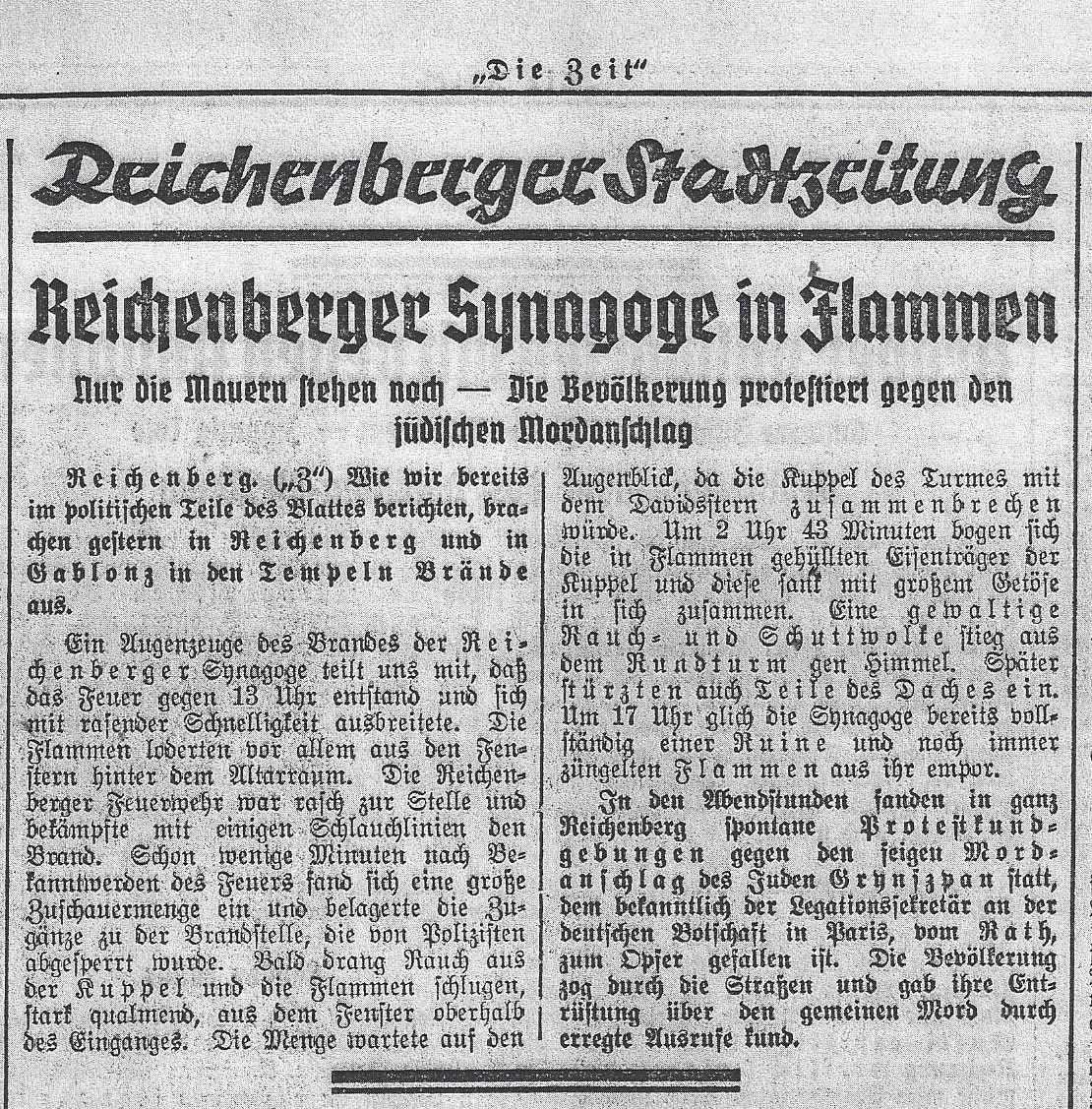
Reading these newspapers, I came face-to-face with life as it had been back then, unfiltered by hindsight. Even though from September 1938 on, Die Zeit, Reichenberg’s city newspaper, had been a Nazi organ, it was still a fascinating read.
The November 11, 1938 edition gleefully described the destruction of Reichenberg’s synagogue during Kristallnacht. An image of the burned-out synagogue featured the caption: “Only the walls are left standing—the population protests the Jewish murderous attack.” This referred to the pretext for the Kristallnacht pogrom, namely the assassination of German diplomat Ernst vom Rath by Herschel Grynszpan, a seventeen-year-old Polish Jew, in Paris on November 7, 1938.
As far as I know, my great-uncle Guido never found out that the synagogue his father helped build went up in flames. He was already in a sanatorium, suffering from diabetes, in and out of consciousness. My grandmother spent that day at his bedside. By that time, he and my great-aunt Resi were divorced, presumably so she, the “Aryan,” could continue to run his textile business, save the family’s livelihood, and ferry her half-Jewish children through the Nazi inferno.
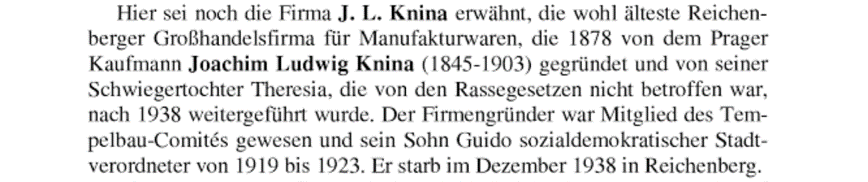
In 2012, when my manuscript was already finished, another book on the history of the Jews of Reichenberg was published: Reichenberg und seine jüdischen Bürger by Isa Engelmann. Thankfully for my project, it confirmed the family story that Guido’s wife, my great-aunt Theresia (called “Resi” by the family), took over the business Joachim Ludwig Knina had founded in 1878 and that Guido (his son) had run until 1938:
“We should also mention here the company J.L. Knina, probably Reichenberg’s oldest wholesaler for manufactured goods, founded in 1878 by the Prague Merchant Joachim Ludwig Knina (1845-1903), which from 1938 on was run by his daughter-in-law Theresia Knina, who wasn’t subject to the racial laws.”
To keep up appearances, Resi had no contact with Guido after the divorce. Instead, my grandparents cared for him. They bribed the staff so he could stay in the sanatorium, as Jews were barred from all kinds of institutions by then. When he passed away in December 1938, they arranged for his funeral.
It is, of course, nice when history books confirm what your family has been telling you, but you owe it to your project to double-check.
If you find family stories contradicted, you need to investigate. Then the quest to figure out the real story can become the story you tell, or the story of why your family told a different story becomes the story. There’s always a story to tell—it just might not be the one you thought you were telling.
Keep in mind: No document, no artifact, tells the whole story.
Graves are their own form of documentation. Many years after Guido’s death, his son Ludwig, the only relative to remain in Reichenberg, had my family’s and Guido’s graves put together because, after the war, German graves were often vandalized in Czechoslovakia.
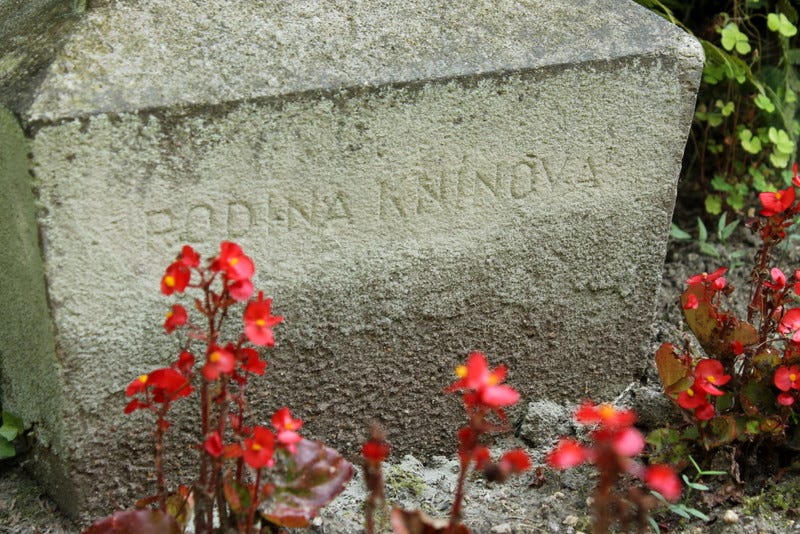
Nowadays, the family gravestone only reads “Rodina Kninova” (Family Knina). Unless you request to see the register for this grave, which I did, you wouldn’t know that my relatives with the last name Berndt are also buried there.
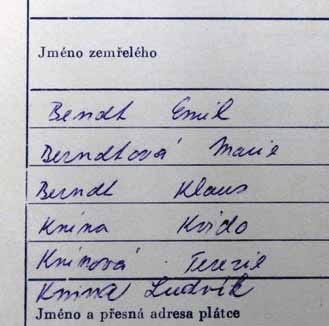
Again, one piece of evidence, namely the grave, told only part of the story. The associated register tells another. But even together, they are not the whole story. Nowhere, except in my family’s oral history, will you find that Guido, buried there, was Jewish.
It all needs to come together—artifacts, documents, and lore—to round out the picture.
And even then, I am not convinced that it is the whole story. What remains of a life, of all lives, is always fragments. Once a subsequent generation finds these fragments, it depends on how they piece them together, as to what story might be told of the past.

A version of this essay appears in my book How to Write Compelling Stories from Family History and was first published on Rivka’s Yiddish.
I needed this. I’ve been writing what I now perceive to be a verse memoir. My biggest struggle has been trying to understand my family history by reimagining since I don’t have a lot of information for reference.
For example, my maternal great-great-grandmother is an Afrocuban woman. And all i have from my grandmother is her name, not much else.
So my question to you is:
If “memory” comes about as a reimagining in order to fill the gaps (while taking historical context into consideration) can that count as memory and, thus, memoir?
As always your writing about your life, family, connections and history makes me think of my own, and the work I do as a historian. That’s the way it should be I think, good writing should provoke or move the reader towards something deeper…I am now going to find this book and savor it. Thanks Annette for your meaningful words…